

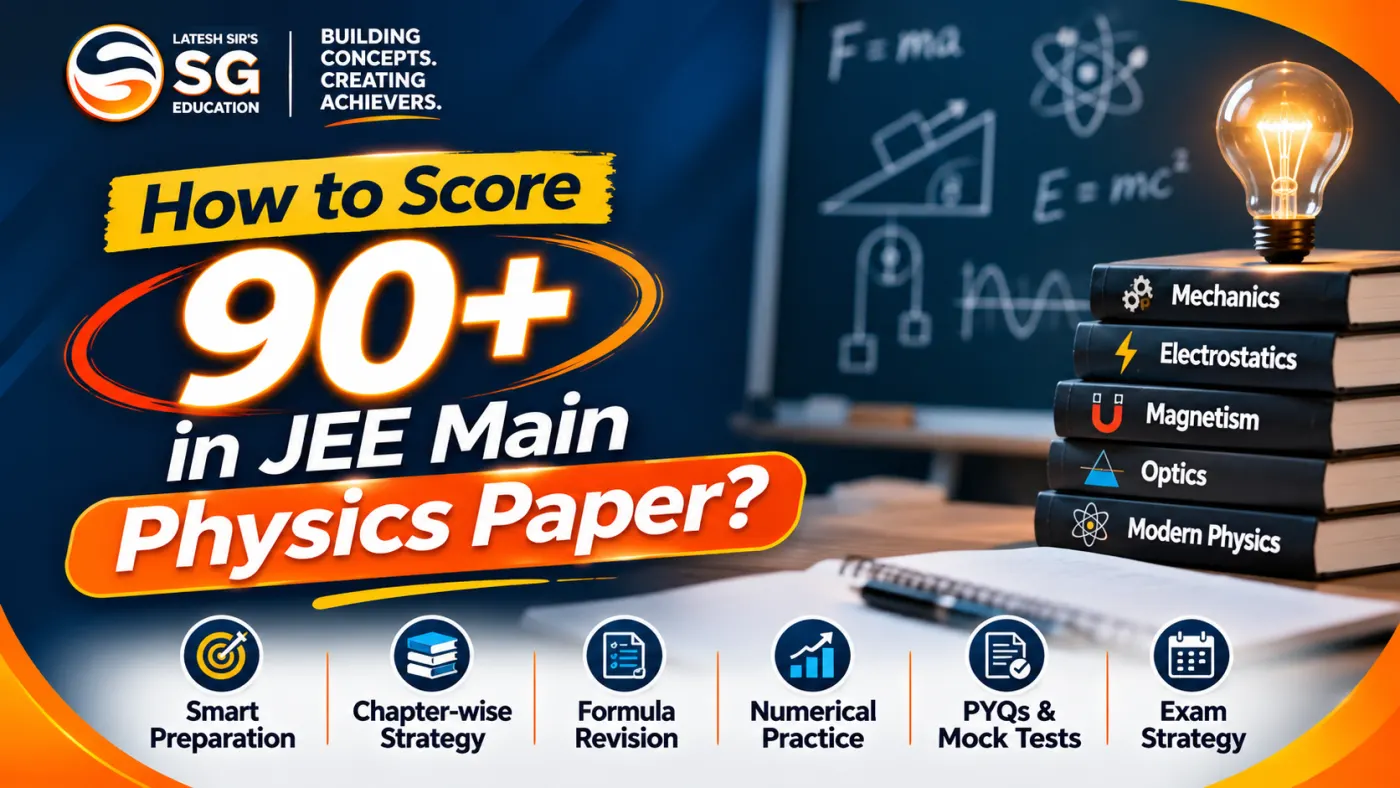
Scoring 90+ marks in JEE Main Physics is an achievable target for students who combine strong conceptual understanding, consistent numerical practice, regular revision and smart examination techniques.
Physics is often considered one of the most challenging subjects in JEE Main because it tests both conceptual clarity and problem-solving ability. However, with the right preparation strategy, students can turn Physics into one of their strongest scoring subjects.
If you are preparing for JEE Main 2027, this guide will help you understand how to prepare Physics systematically and target 90+ marks.
1. Understand the JEE Main Physics examination pattern
Physics carries 100 marks in JEE Main Paper 1 (B.E./B.Tech).
Students should understand:
-
Question types and marking scheme.
-
Negative marking.
-
Chapter-wise syllabus.
-
Numerical and conceptual question patterns.
-
Time management during the examination.
The exact pattern should always be checked in the latest NTA Information Bulletin.
Your target: Aim for high accuracy rather than attempting every question. With negative marking, careless attempts can reduce your score.
2. Focus on high-priority Physics chapters
A common mistake students make is preparing chapters randomly without understanding their importance or building the necessary fundamentals.
Organise your preparation around the following major areas.
Mechanics
-
Units and Dimensions
-
Kinematics
-
Laws of Motion
-
Work, Energy and Power
-
Centre of Mass
-
Rotational Motion
-
Gravitation
Heat and Thermodynamics
-
Thermal Properties of Matter
-
Thermodynamics
-
Kinetic Theory of Gases
Electricity and Magnetism
-
Electrostatics
-
Capacitance
-
Current Electricity
-
Moving Charges and Magnetism
-
Magnetism and Matter
-
Electromagnetic Induction
-
Alternating Current
Optics
-
Ray Optics
-
Wave Optics
Modern Physics
-
Dual Nature of Matter and Radiation
-
Atoms
-
Nuclei
-
Electronic Devices
Do not completely skip any chapter based on assumptions about weightage. NTA can vary the distribution of questions across examination shifts.
3. Master concepts before solving advanced problems
The biggest difference between an average Physics student and a high-scoring student is conceptual clarity.
For every chapter, follow this sequence:
-
Understand the fundamental concepts.
-
Learn the important formulas and their applications.
-
Solve basic examples.
-
Practise moderate-level numerical questions.
-
Attempt JEE Main previous years' questions.
-
Solve mixed-concept problems.
For example, in Current Electricity, do not simply memorise Ohm's law. Understand resistance, resistivity, series-parallel combinations, Kirchhoff's laws and their practical applications.
Remember: Memorising formulas may help you solve familiar questions, but conceptual understanding helps you solve unfamiliar ones.
4. Prepare a Physics formula notebook
Formula revision is essential for scoring 90+.
Maintain a separate notebook containing:
-
Important formulas.
-
Definitions and fundamental concepts.
-
Units and dimensions.
-
Graphs and their interpretations.
-
Important derivations and relationships.
-
Common numerical shortcuts.
-
Frequently made mistakes.
Revise this notebook regularly.
Avoid preparing lengthy notes that take too much time to revise. Your formula notebook should be concise and useful during the final revision phase.
5. Solve previous years' JEE Main questions
Previous years' questions (PYQs) are among the most important resources for JEE preparation.
They help you understand:
-
The difficulty level of questions.
-
Frequently tested concepts.
-
Numerical problem-solving approaches.
-
Conceptual question patterns.
-
The application of formulas.
Recommended approach:
-
Solve chapter-wise PYQs immediately after completing each chapter.
-
Attempt questions without looking at solutions.
-
Mark difficult questions for revision.
-
Revisit incorrect questions after a few days.
-
Practise complete papers under timed conditions.
Do not measure preparation only by the number of questions solved. Measure it by your ability to solve questions independently and accurately.
6. Practise numerical problems every day
Physics requires regular problem-solving practice.
A suggested daily practice target:
|
Activity |
Questions |
|---|---|
|
Basic conceptual problems |
10 |
|
Moderate numerical problems |
15 |
|
JEE Main PYQs |
15 |
|
Mixed-concept questions |
10 |
|
Total |
50 |
These are suggested targets, not compulsory numbers. Adjust them according to your preparation level and chapter difficulty.
The objective is to develop:
-
Calculation speed.
-
Conceptual application.
-
Accuracy.
-
Confidence.
-
Problem-solving flexibility.
7. Follow a structured daily Physics timetable
Students preparing for JEE Main should allocate dedicated time to Physics every day.
|
Activity |
Time |
|---|---|
|
Concept learning |
45 minutes |
|
Formula revision |
15 minutes |
|
Numerical practice |
60 minutes |
|
PYQs |
45 minutes |
|
Error analysis |
15 minutes |
|
Total |
3 hours |
Consistency matters more than studying for long hours occasionally.
8. Take regular chapter-wise and full-length tests
Testing is one of the most important parts of JEE preparation.
A structured Physics assessment plan can include:
-
Chapter-wise tests after completing each chapter.
-
Weekly Physics assessments.
-
Cumulative tests covering multiple chapters.
-
Full-length JEE Main mock examinations.
After every test, analyse:
-
Which questions were answered incorrectly?
-
Which concepts were not understood?
-
Which calculations took too long?
-
Where did negative marking occur?
-
Which chapters require additional revision?
Maintain a record of your performance and work on your weakest areas.
9. Learn smart time management for the Physics paper
Even students with strong conceptual understanding can lose marks because of poor time management.
During the examination:
-
Start with questions you understand confidently.
-
Avoid spending too much time on one difficult numerical.
-
Identify lengthy calculations early.
-
Mark questions for review.
-
Recheck important calculations.
-
Avoid blind guessing.
Practise different question-selection strategies during mock tests. Find the approach that gives you the best combination of speed and accuracy.
10. Common mistakes that prevent students from scoring 90+
Avoid these preparation mistakes:
-
Memorising formulas without understanding concepts.
-
Ignoring fundamental chapters.
-
Solving only easy questions.
-
Avoiding previous years' questions.
-
Not practising numerical problems regularly.
-
Studying from too many books.
-
Ignoring mock-test analysis.
-
Not revising completed chapters.
-
Spending too much time on difficult questions.
-
Neglecting accuracy.
A 90+ target requires discipline and continuous improvement, not shortcuts.
11. How SG Education prepares students for JEE Physics
At Latesh Sir's SG Education, our academic approach focuses on developing strong conceptual foundations and problem-solving abilities.
Through our JEE Rankers Batch (JRB) and SG Mission IIT & NEET 2029, students follow a structured preparation system.
Our academic approach includes:
-
Concept-based Physics teaching.
-
Systematic chapter-wise syllabus planning.
-
Daily Practice Problems (DPPs).
-
Numerical problem-solving sessions.
-
Previous years' JEE questions.
-
Chapter-wise assessments.
-
Regular Physics tests.
-
Combined PCM examinations.
-
Doubt-solving support.
-
Performance analysis and revision.
Our objective is to help students understand Physics deeply, practise consistently and develop the examination skills needed for competitive examinations.